Are you struggling with complex fractional mathematics? A reliable Mixed Number Calculator can save you significant time and eliminate frustrating computational errors. Whether you are a student, professional builder, or chef, mathematical precision is absolutely crucial to your success.
Our free online Mixed Number Calculator delivers instant, high-precision results for all your fraction needs. You can easily add, subtract, multiply, and divide complex numbers with step-by-step algebraic parsing. There is no installation, software download, or account sign-up required to use this tool.
About the Mixed Number Calculator
Managing fractions manually often leads to simple yet frustrating calculation errors. A dedicated Mixed Number Calculator removes this friction entirely by automating the tedious mathematical steps. It provides instant, accurate results for everyday math problems without the stress of manual verification.
You can process complex equations seamlessly without needing a physical device or a complicated desktop spreadsheet. Using our Mixed Number Calculator ensures absolute accuracy before you make critical project decisions. It is perfectly designed for educational research, professional contract work, and daily mathematical computations.
Explore all 145+ free calculators on CalculatorzKit to streamline your workflow. We cover a massive range of tools across finance, health, math, engineering, education, and construction.
The Core Breakdown: Formulas & Methodology
Understanding exactly how a Mixed Number Calculator operates helps build your foundational math skills. The tool relies on verified, internationally recognized algebraic standards to process your inputs. Every single operation is logically broken down into manageable mathematical steps.
First, the Mixed Number Calculator transforms your input into an improper fraction. The rule is highly straightforward: multiply the whole number by the denominator, then add the original numerator. This newly calculated value is then placed directly over the original denominator.
Next, the system applies the appropriate mathematical operation based on your selection. For addition and subtraction, the Mixed Number Calculator finds the Lowest Common Multiple (LCM) to establish a common denominator. For multiplication, it simply multiplies straight across the top and bottom values.
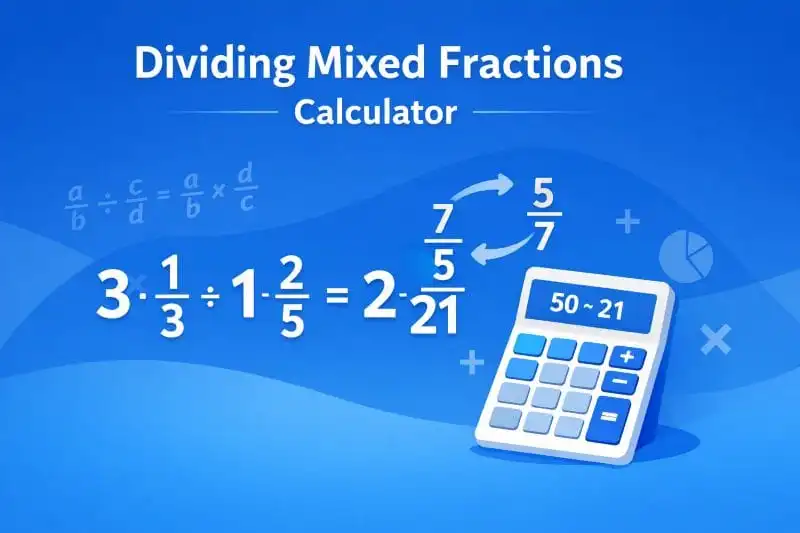
For division equations, the tool utilizes a reciprocal multiplication rule by flipping the second fraction upside down. Finally, the Mixed Number Calculator converts the resulting improper fraction back into a clean mixed number using standard floor division techniques.
📐 Formula & Methodology
Improper Transformation: Numerator = (Whole × Denominator) + Original Numerator
Common Denominator (LCD): Lowest Common Multiple of Denominator 1 and 2
Reciprocal Rule (Division): Invert the secondary fraction and multiply directly
Mixed Conversion: Whole Number = Math.floor(Final Numerator ÷ Final Denominator)
Practical Guide: Fractional Data Matrix
Visualizing your data is crucial when working with diverse numerical formats and measurements. A high-quality Mixed Number Calculator bridges the mathematical gap between whole numbers, improper fractions, and standard decimals. The reference table below clearly illustrates how these different numerical formats relate to one another.
This functional matrix highlights the most common conversions you might encounter in your daily tasks. Keep this comparative data handy when double-checking your Mixed Number Calculator outputs to ensure total accuracy.
| Mixed Number | Improper Fraction | Decimal Equivalent | Common Real-World Use Case |
|---|---|---|---|
| 1 1/2 | 3/2 | 1.50 | Baking and culinary measurements |
| 2 3/4 | 11/4 | 2.75 | Carpentry, framing, and wood cuts |
| 3 1/3 | 10/3 | 3.33 | Time tracking and payroll hours |
| 5 5/8 | 45/8 | 5.625 | Machining and engineering tolerances |
How to Use This Mixed Number Calculator
Operating this intuitive Mixed Number Calculator requires absolutely zero technical expertise. Simply input your whole numbers, numerators, and denominators directly into the designated blank fields. Select your desired mathematical operation from the central dropdown menu to proceed.
Once you hit the primary calculation button, the Mixed Number Calculator generates an instant, hyper-precise answer. You can easily swap operations or adjust your input values dynamically on the fly. The system updates automatically to reflect your latest mathematical parameters in real-time.
Real-World Practical Applications
A highly accurate Mixed Number Calculator is an indispensable tool for multiple demanding professions. Carpenters, general contractors, and metalworkers rely on it heavily to guarantee perfectly measured structural cuts. Miscalculating a fraction by even a sixteenth of an inch can ruin costly construction materials.
Similarly, culinary professionals and home bakers use a Mixed Number Calculator to scale complex recipes efficiently. Changing serving sizes requires exact fractional adjustments so that delicate flavor profiles remain perfectly balanced. It completely eliminates the costly guesswork from the commercial kitchen environment.
Educators and students also benefit heavily from this accessible digital resource. A Mixed Number Calculator serves as the perfect study companion for verifying manual algebraic homework. It empowers remote learners to check their mathematical logic instantly and confidently.
🔗 Related Calculators You May Need
💡 Quick Usage Tips
- Use the 📋 Copy button to instantly paste your calculated results into professional documents or messages.
- Use the 📧 Email button to send complex calculation outputs directly to yourself or a colleague.
- Bookmark this specific page for rapid daily access — the tool functions perfectly offline once the page is fully loaded.