Electrical efficiency depends heavily on minimizing power losses across long transmission lines. Utilizing a precise voltage drop calculator ensures your electrical systems function safely and comply with industry standards.
Whether you are sizing a residential branch circuit or mapping heavy industrial feeders, tracking line losses prevents catastrophic equipment damage. This advanced voltage drop calculator streamlines complex engineering equations into an instantaneous, intuitive interface.
It helps designers, technicians, and commercial electricians immediately determine how different conductor parameters affect line performance. Maximizing system efficiency has never been easier than with our reliable voltage drop calculator.
Why Tracking Line Loss Matters
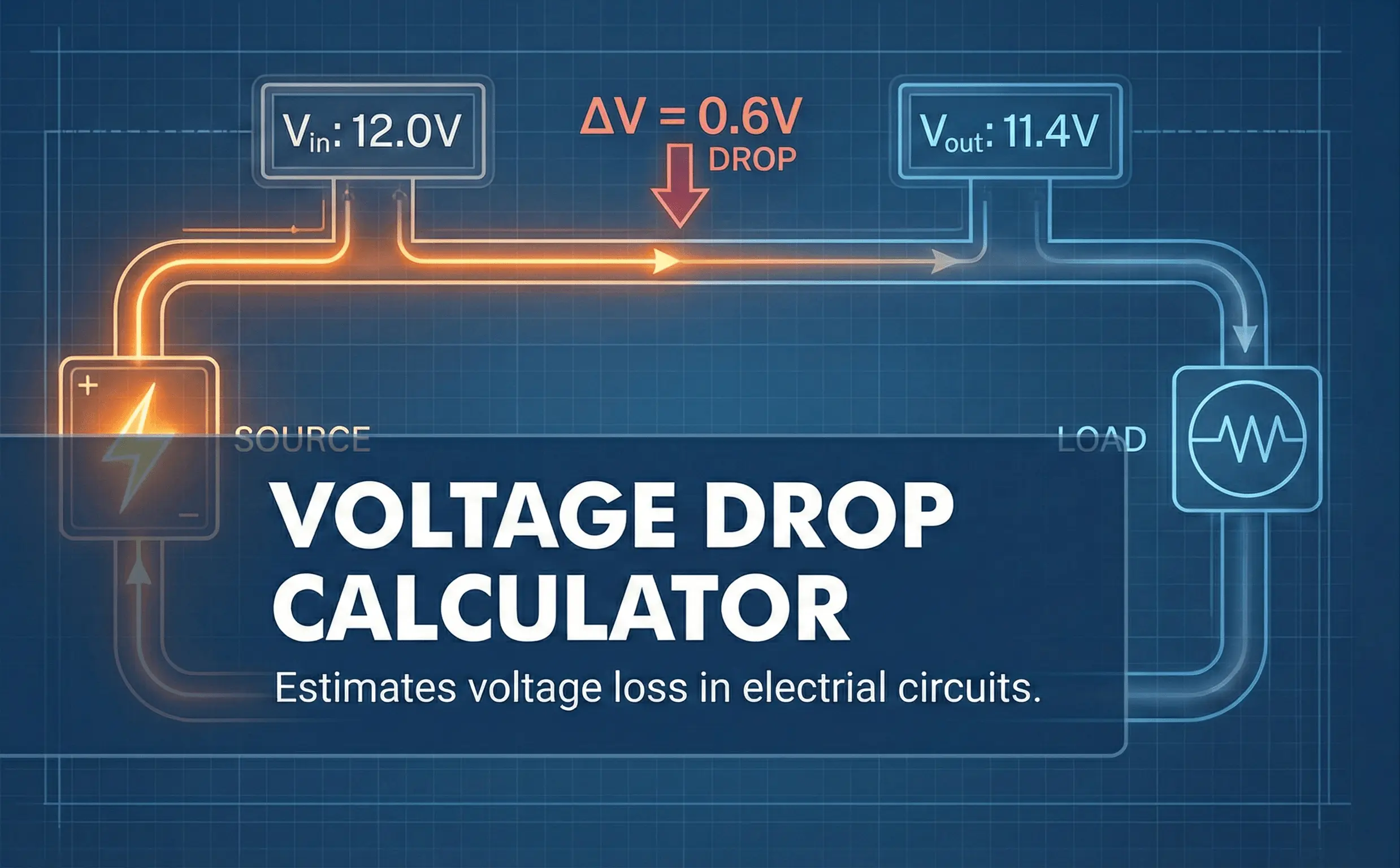
Voltage drop represents the structural reduction in electrical potential values that occurs as current runs through conductor paths. When this loss value exceeds acceptable thresholds, electric motors run hot, lights flicker, and sensitive control systems fail.
Therefore, integrating a professional voltage drop calculator into your early-stage design workflow is an indispensable best practice. According to standard requirements updated inside the National Electrical Code (NEC) guidelines, branch circuits should maintain a maximum drop of 3%.
The absolute maximum cumulative total spanning from main feeders down to the furthest terminal device should never exceed 5%. Using a validated voltage drop calculator guarantees your field infrastructure meets these rigorous safety benchmarks.
The Core Calculation Breakdown
Understanding the exact mathematical relationships behind our voltage drop calculator ensures better real-world engineering choices. The tool processes conductor losses using fundamental principles derived directly from Ohm’s Law matrices.
The underlying system easily supports both single-phase and balanced three-phase alternating current environments. For a standard single-phase layout, the internal engine of the voltage drop calculator implements a highly precise mathematical matrix.
📐 Formula & Methodology
Single-Phase Ohm's Law Matrix: Voltage Drop = (2 × K × I × Length) ÷ Circular Mils
Three-Phase Balanced Matrix: Voltage Drop = (√3 × K × I × Length) ÷ Circular Mils
Percentage Loss Vector: (Calculated Voltage Drop ÷ Source Supply Voltage) × 100
Within this single-phase model, the symbol K represents the specific material resistivity constant of the metal wire. Meanwhile, I stands for the load current in amperes, Length marks the total conductor distance in feet, and Circular Mils refers to the wire cross-sectional area.
Each of these unique variables directly alters the final voltage drop calculator output. When configuring a balanced three-phase industrial setup, the equation must integrate a critical phase vector to remain accurate.
The revised calculation inside the voltage drop calculator scales directly by the square root of three (~1.732). This specific geometric modification accounts for the 120-degree phase separation inherent to commercial three-phase distribution lines, enabling the voltage drop calculator to maintain absolute precision.
Practical Guide & Conductor Selection Matrix
Choosing the ideal conductor requires cross-referencing your calculated system values with a standardized wire size matrix. Below is a clean, text-based data table highlighting typical resistance properties for copper and aluminum conductors.
| Conductor Material | Resistivity Constant (K) | Recommended Application |
|---|---|---|
| Copper (Solid) | 12.9 ohms-mil/ft | Residential branch circuits and indoor grids |
| Copper (Stranded) | 12.9 ohms-mil/ft | Flexible industrial conduits and machinery |
| Aluminum (Solid) | 21.2 ohms-mil/ft | Heavy commercial feeders and overhead lines |
| Aluminum (Stranded) | 21.2 ohms-mil/ft | Main service entrance paths and utility grids |
You can easily verify these physical variables against your voltage drop calculator results for optimal configuration choices. Matching the exact material constant is absolutely vital for obtaining accurate calculation parameters.
For instance, the specific copper material constant is standardized at 12.9 ohms-mil/ft at 75°C. Aluminum exhibits a higher internal resistance profile, carrying a standardized material constant of approximately 21.2 ohms-mil/ft under identical thermal conditions.
When entering data into the voltage drop calculator, ensuring your material selections align with these specific engineering constants prevents downstream performance discrepancies. Let this data guide your system configurations.
Engineering Applications
The sheer versatility of a high-precision voltage drop calculator makes it incredibly valuable across multiple commercial sectors. Electrical engineering teams rely heavily on it to size major power grid distribution networks efficiently.
Mechanical and civil engineers also apply these metrics when deploying heavy plant machinery or remote industrial pump stations. Furthermore, electronics hobbyists and circuit designers frequently employ a voltage drop calculator to protect delicate power rails.
Ensuring stable voltage delivery is equally critical for residential solar panel arrays and modern electric vehicle charging hubs. No matter the physical scale of your project, utilizing a voltage drop calculator extends hardware lifespan and optimizes long-term power efficiency.
Unit Consistency & Engineering Accuracy Notes
Maintaining complete unit consistency remains the single most critical factor for generating dependable calculation results. Mixing imperial wire lengths with metric cross-sections will invariably cause severe calculation errors inside your system.
Before inputting values into the voltage drop calculator, make sure all external engineering metrics are standardized. Our high-precision computational tool outputs metrics to multiple significant figures, making it perfectly suitable for complex blueprints.
However, for high-stakes or safety-critical applications, always double-check your voltage drop calculator outcomes against localized official regulatory codebooks. Combining automated software speed with trusted professional human oversight guarantees perfectly safe engineering designs.
🔗 Essential Utilities for Your Voltage Drop Calculator Workspace
Explore our comprehensive suite of advanced engineering tools to supplement your voltage drop calculator workflows. Keeping your toolkit unified ensures maximum precision across all developmental phases of your technical layouts.
Our web suite features a robust Unit Converter alongside a highly detailed Ohm’s Law Calculator. These connected utilities work smoothly alongside the voltage drop calculator to resolve complex power vectors.